— Platform · The graph model →
Every record is a node. Every hand-off is an edge.
Holonyx stores experiments, registry entries, lots, instruments, recipes, batches, results and signatures as typed nodes in one graph — so lineage is a query, not a cross-system reconstruction.
Edges created at the moment of transition
Recipe —DERIVED_FROM→ Experiment
A recipe knows the experiment it came from — established when it is created, not reconstructed later.
Batch —EXECUTES→ Recipe
Every batch record is bound to exactly one approved recipe version.
QC result —QUALIFIES→ Batch
Test results attach to the batch they release, against a versioned schema.
Signature —SIGNS→ Record
A signature is bound to the exact content it approved; change the content and the mismatch is flagged.
A chain-of-identity report for a cell-and-gene-therapy product is one graph traversal — donor to apheresis to cryopreservation to batch — not a week of cross-referencing spreadsheets.
The live model
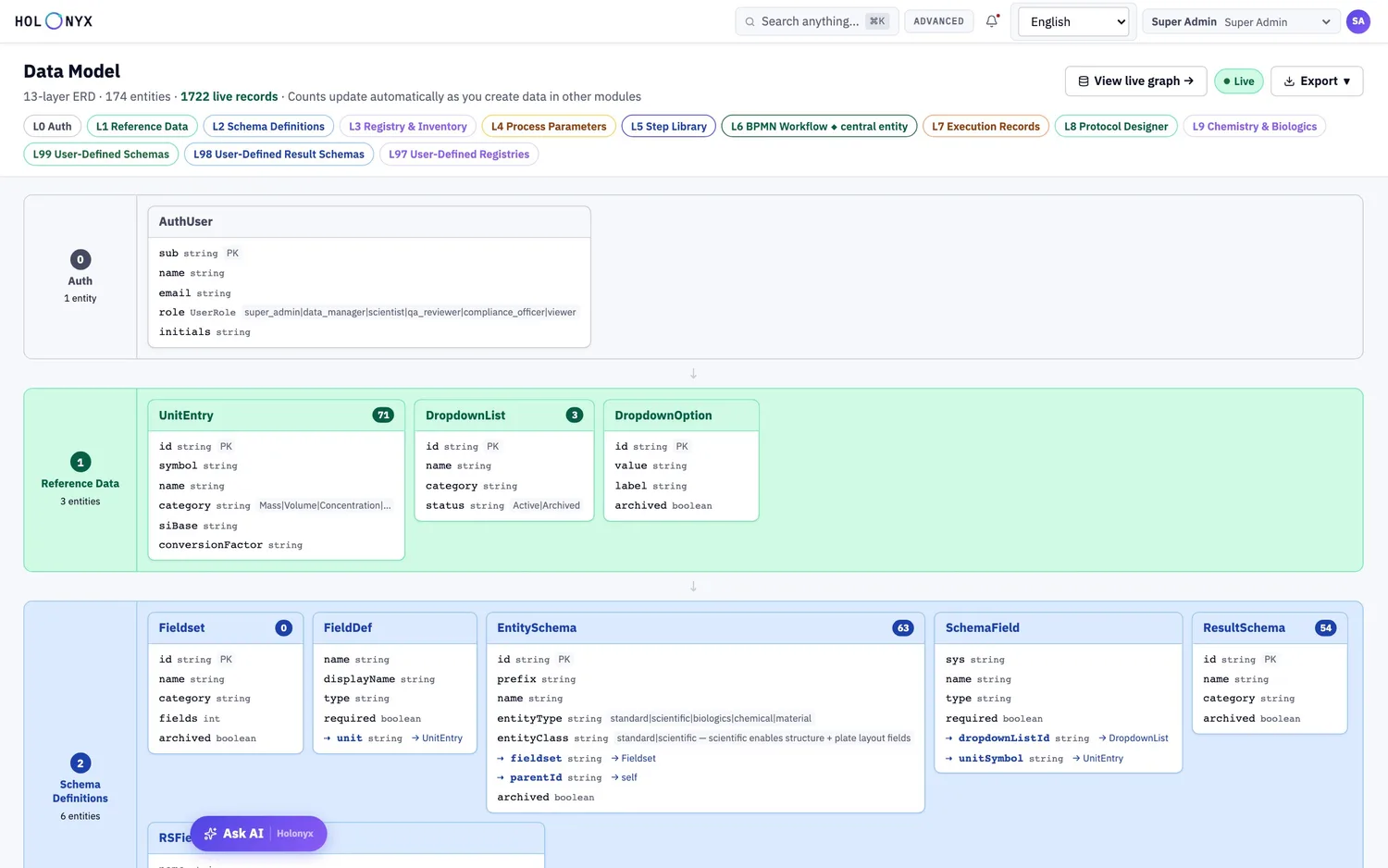
Every entity in 13 layers — the map of what the platform stores.
An interactive entity-relationship diagram generated from the live data model, with record counts that update as data is created. It exports as SVG or PNG for design documentation and validation packages.
- Layers from authentication and reference data through schema definitions, registry and inventory, process parameters, BPMN workflow, execution records, protocols, and chemistry and biologics
Your data model
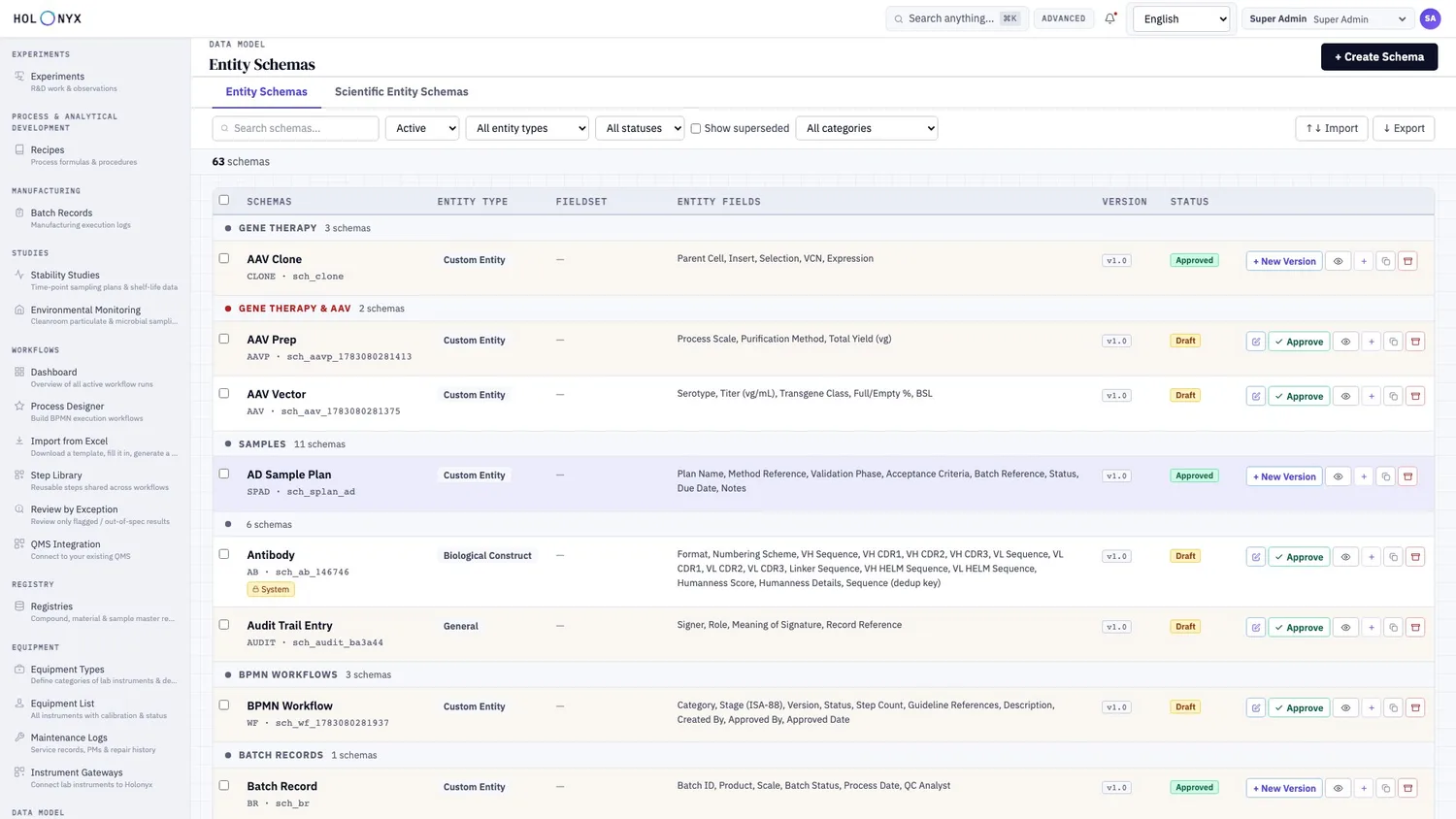
Entity schemas your admins define — versioned like code.
Entity types, fieldsets, dropdowns, units and result schemas are configuration under change control, not code changes. Fields range from text and numbers to SMILES, sequence, calculated values and registry links.
- Draft, Approved, Superseded lifecycle
- Approving a schema is a GxP configuration change and drafts its qualification protocol
- Enroll approved schemas into registries to start capturing entities
Ontology
Map your terms to the standards.
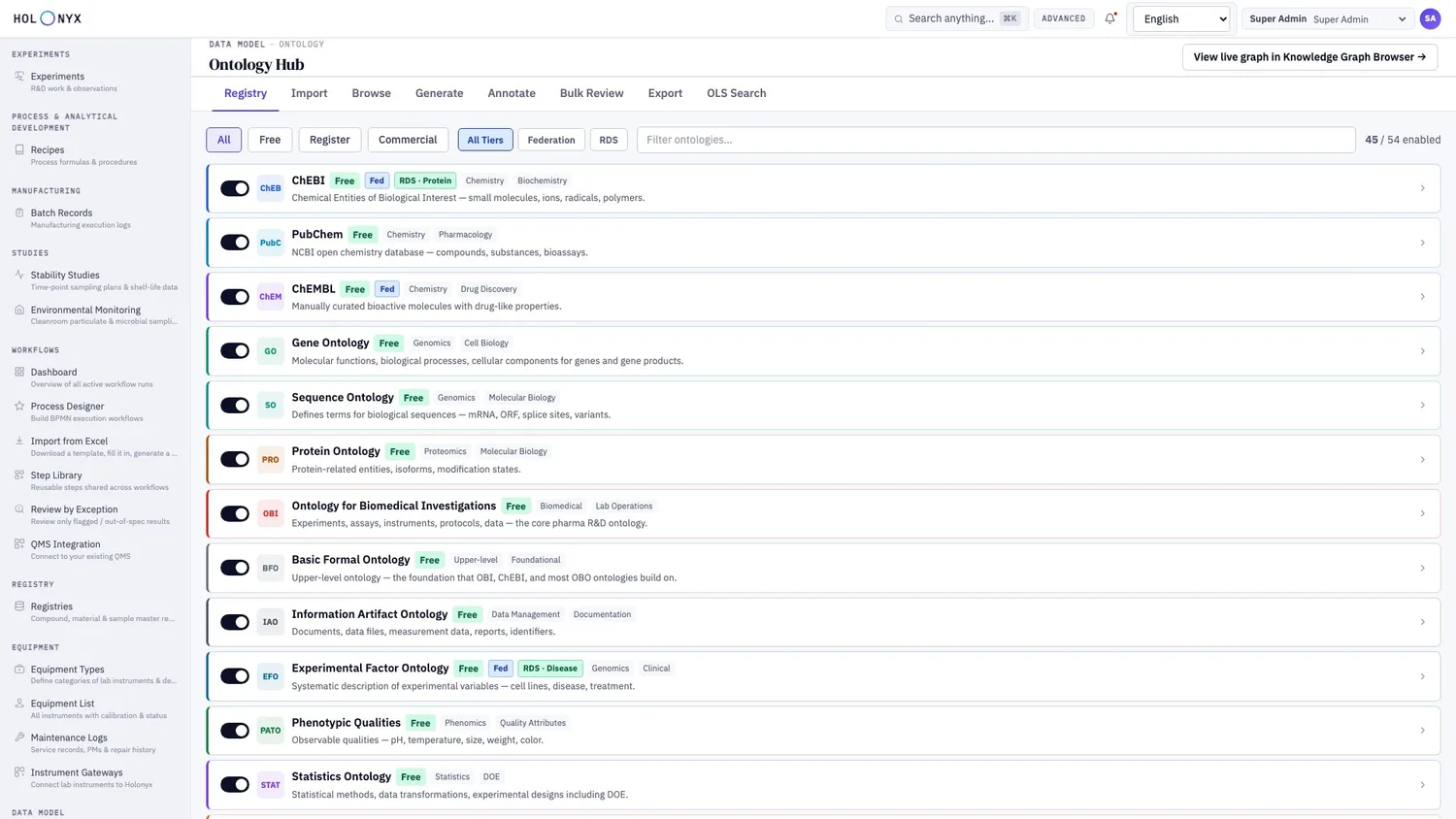
The Ontology Hub imports, annotates, reviews and exports terms from public ontologies — ChEBI, PubChem, ChEMBL, Gene Ontology, OBI, EFO and more — and maps internal field values to standard identifiers, so data stays comparable across programs and partners.
See your own entity types on the graph.
Bring your compound, construct and sample definitions — we will model them live.