— Platform · Research →
A lab notebook built on structured, linked, signed records.
Freeform for exploration, workflow-gated for GxP — on one experiment record that is already connected to your registry, your inventory and the rest of the graph.
Experiments
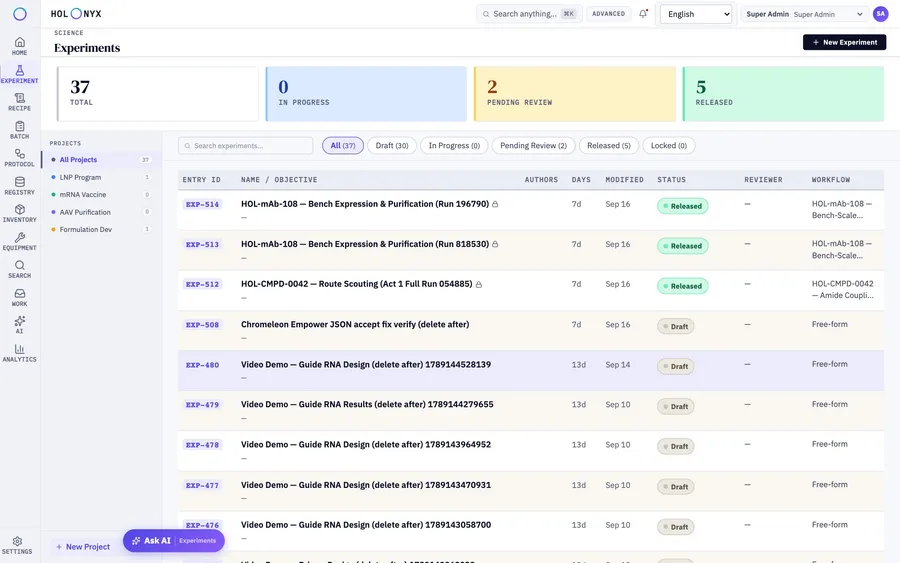
One list for every program — freeform and structured side by side.
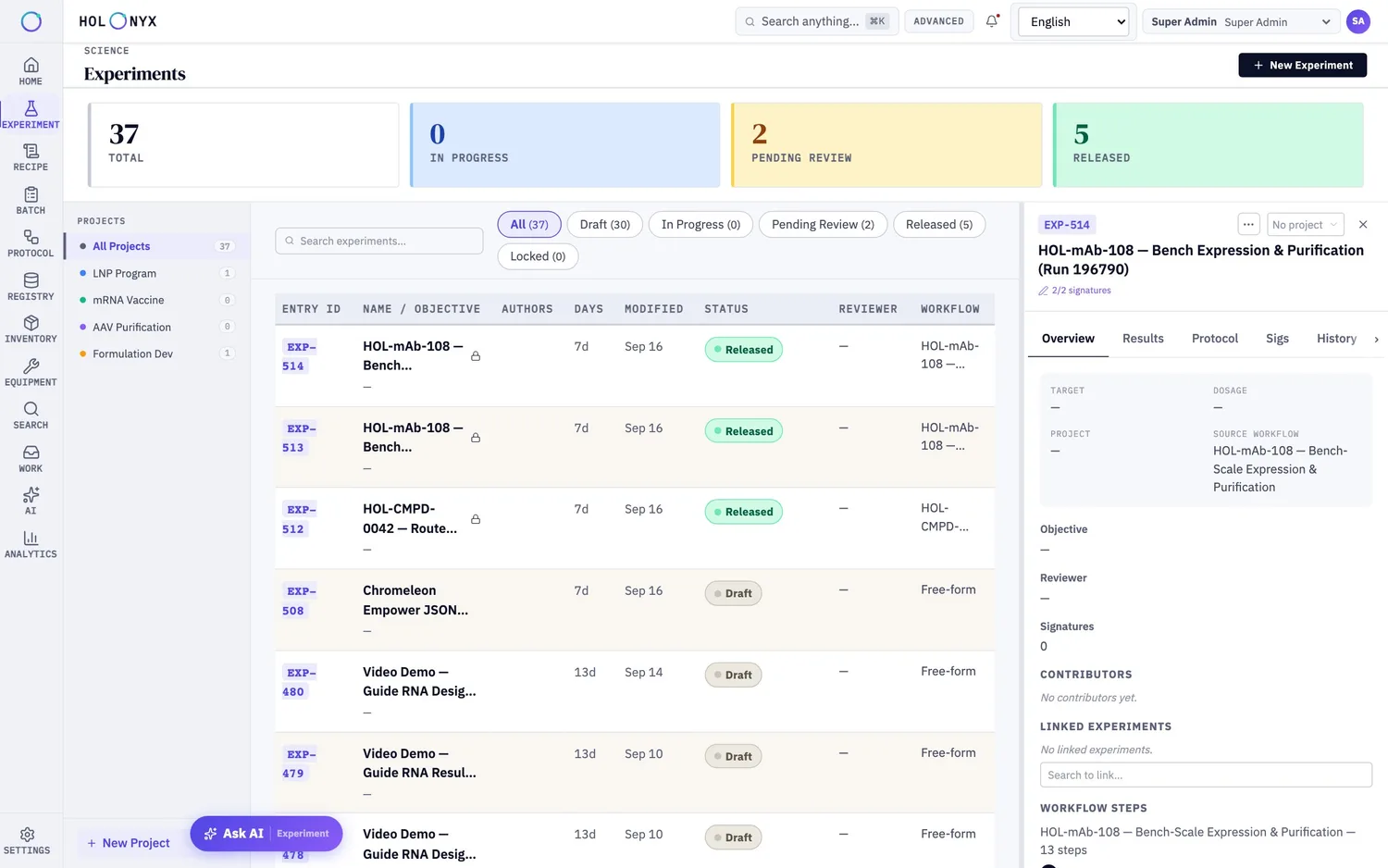
Each experiment carries a project, an entry mode and a status. Some rows name a workflow; others say Free-form. That is deliberate: a lab's history is a mixture, and the platform represents it honestly instead of forcing one schema onto old data.
- Status lifecycle: Draft, In Progress, Pending Review, Released, Locked — the lifecycle decides what can still change.
- Reviewer and workflow columns on the list, so nothing hides in a folder.
- Request QC test creates a linked test request that carries the experiment context.
Capture sections
Ten building blocks for any experiment step.
Every science section parses a real format or resolves a real database ID — nothing is a decorative box. The same blocks are step data sources in the manufacturing process designer.
Smart Text
Rich text with tables and symbols; live chips pull current values from sibling sections.
Attachments
Files with inline preview — PDF, image, DOCX, XLSX — and SVG annotation.
Spreadsheet
An Excel-like grid with live formulas; @mention experiments, registry entries and inventory lots.
References
Literature, URLs and experiment-to-experiment links, typed as reference or fulfillment.
Stoichiometry
Reaction scheme, reagent table, limiting reagent and yield percentage.
Microplate
96/384-well layouts with well roles, outlier flags and reader-file import.
Formulation
Ingredients by modality with layers, process steps and a design-of-experiments generator.
BioAssay
Dose-response IC50 fitting, hit selection and standard curves over the plate map.
Liquid handling
Dispense, transfer, dilute — consuming real inventory lots as they run.
Compound enumeration
SDF library upload with an embedded structure editor; link to inventory or register.
Chemistry
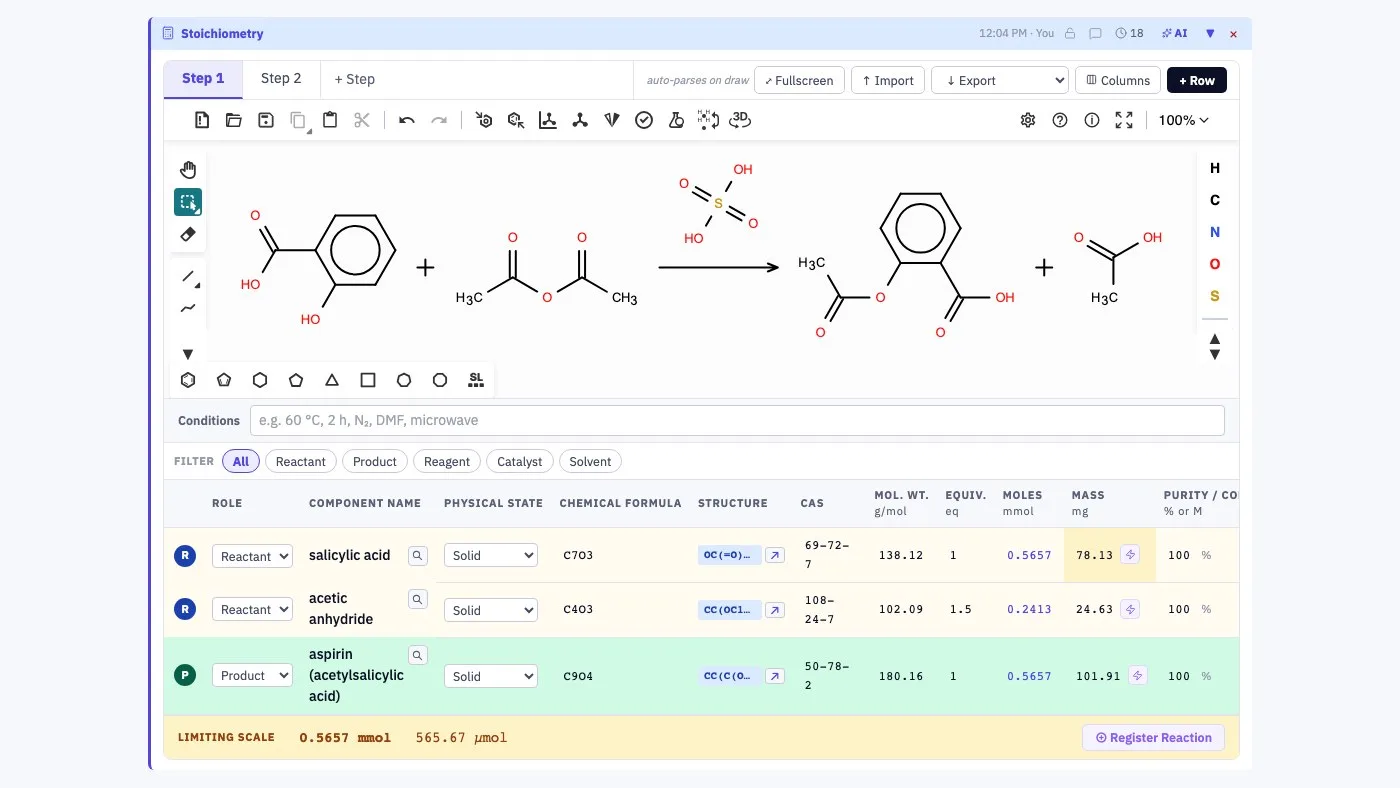
Reaction scheme, stoichiometry and yield in one section.
Draw the reaction, pull reagents from inventory, and let Holonyx compute quantities, the limiting reagent and yield — then register the product without leaving the entry.
- Structure editor with PubChem-resolved names and properties
- Equivalents, moles, mass and purity per reagent; the limiting scale is flagged
- Actual versus theoretical mass gives yield percentage automatically
Formulation & DoE
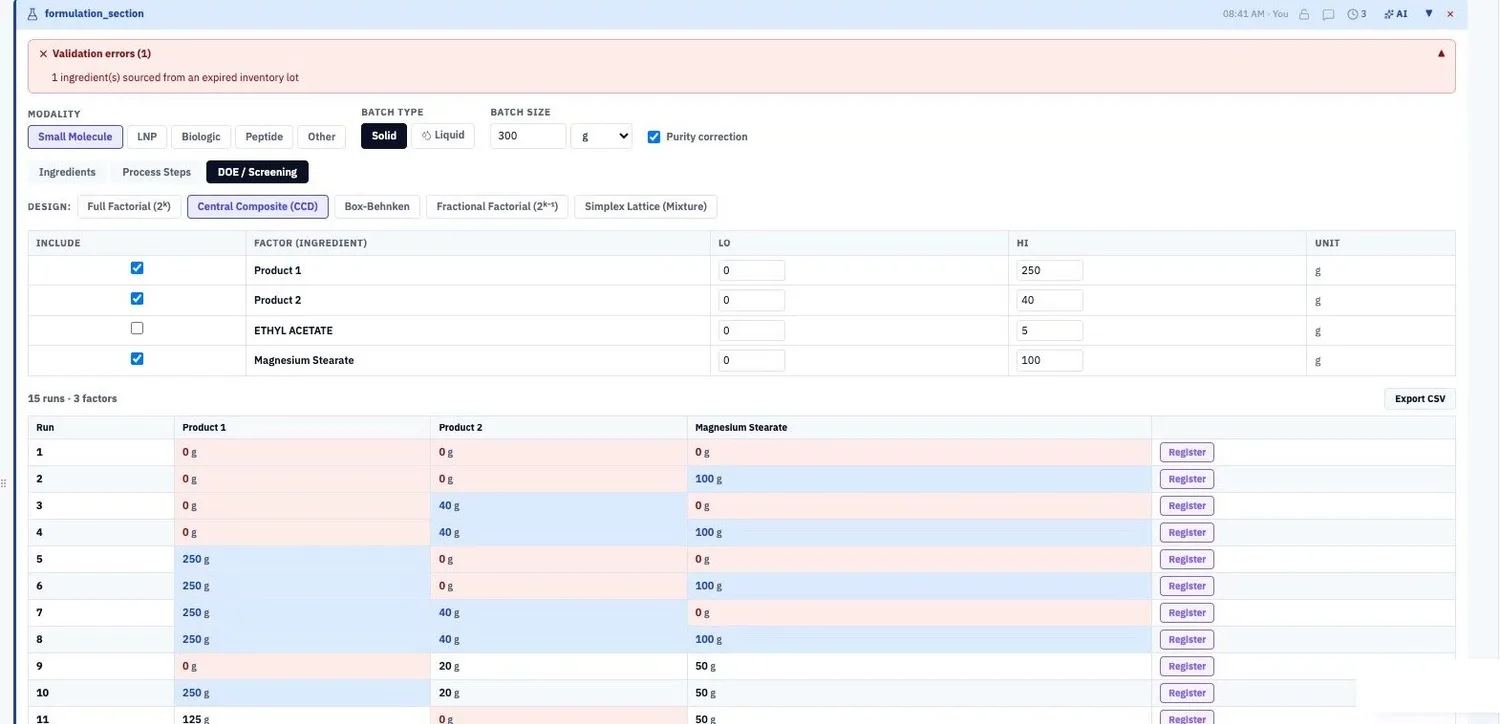
Formulation and design of experiments, inside the notebook.
Composition by layer with purity correction and lot-aware sourcing, then a designed run matrix — each run registered as a linked experiment.
- Modality tabs: small molecule, LNP, biologic, peptide.
- Expired lots are flagged with a validation error as soon as they are used.
- Design types: full factorial, central composite, Box-Behnken, fractional factorial, simplex lattice.
Plates & bioassays
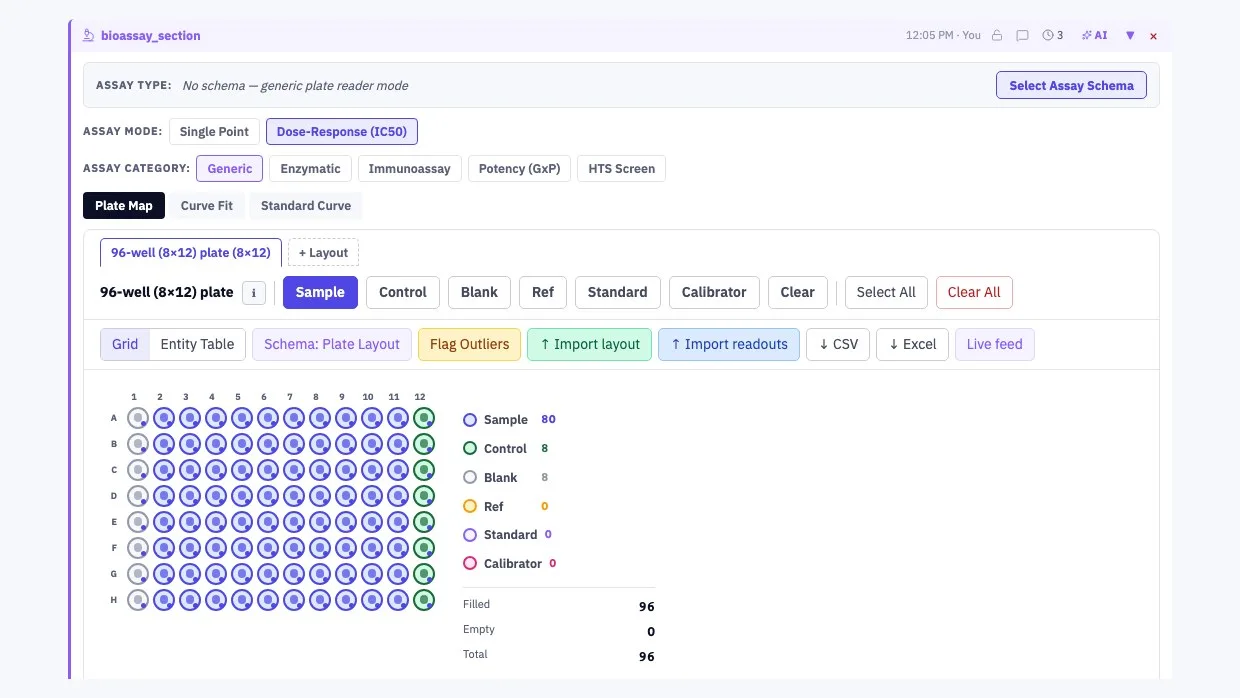
From plate layout to IC50 without leaving the record.
A real 96/384-well data model with typed roles — sample, control, blank, reference, standard, calibrator — and imports that preview every well before it is committed.
- Reader-file mapping brings measured values onto the plate
- Dose-response fitting, hit selection and standard-curve calibration on the same plate map
Liquid handling
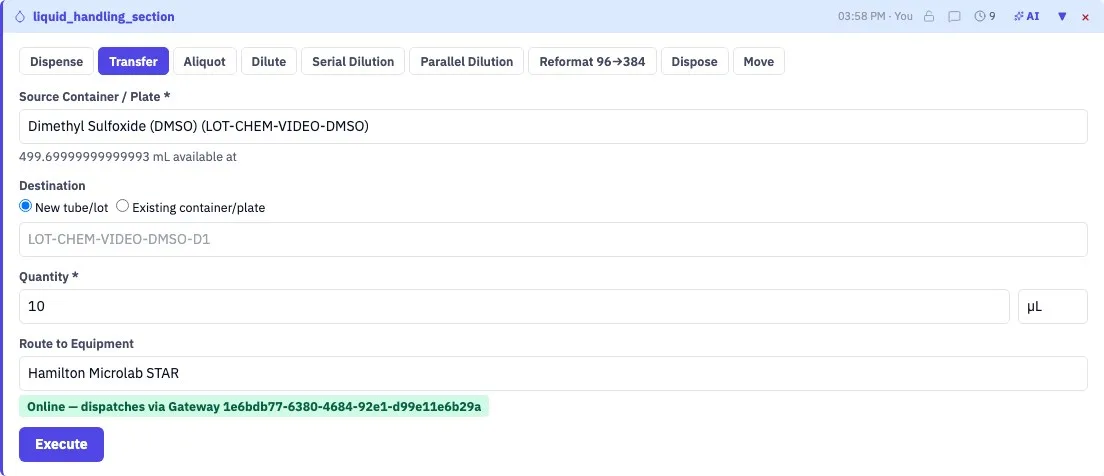
Liquid handling that consumes real inventory.
Dispense, transfer, aliquot, dilute serially or in parallel, and reformat 96→384 — and the inventory follows the science.
- Running a dilution creates a new lot and updates the source quantity.
- Worklist export as CSV for a liquid-handling robot.
Viewers & design tools
Twelve scientific viewers — file in, real analysis out.
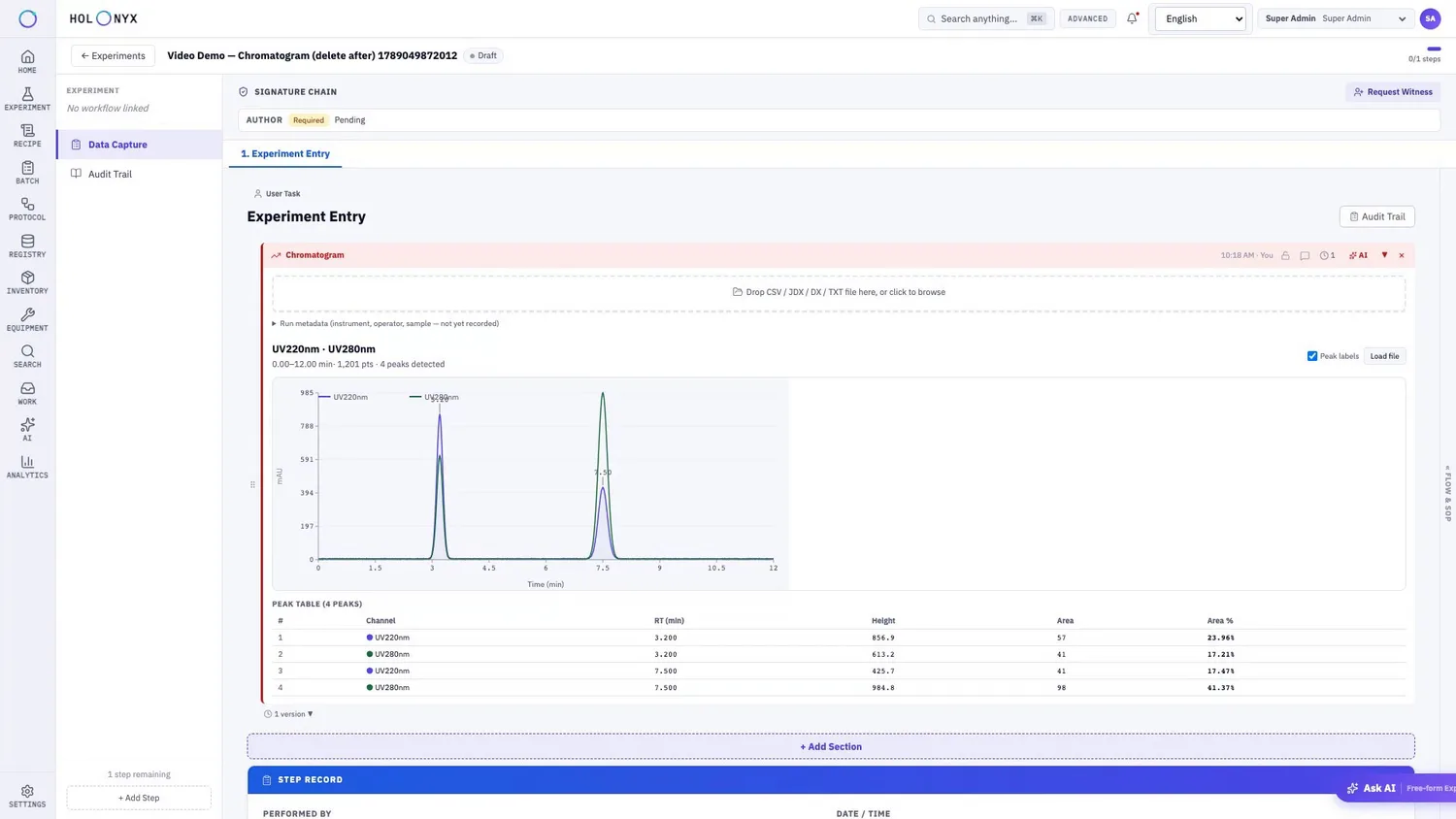
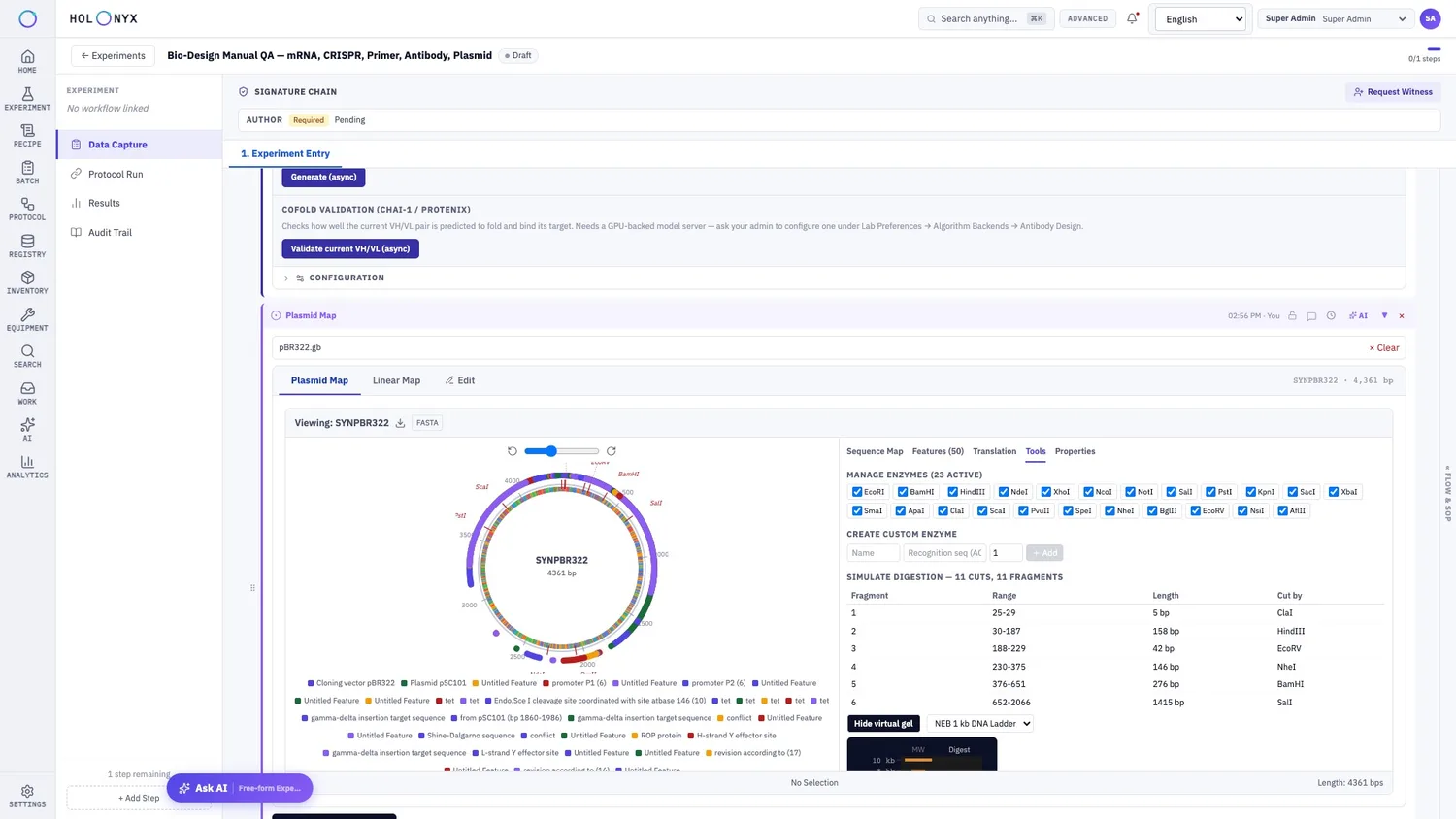
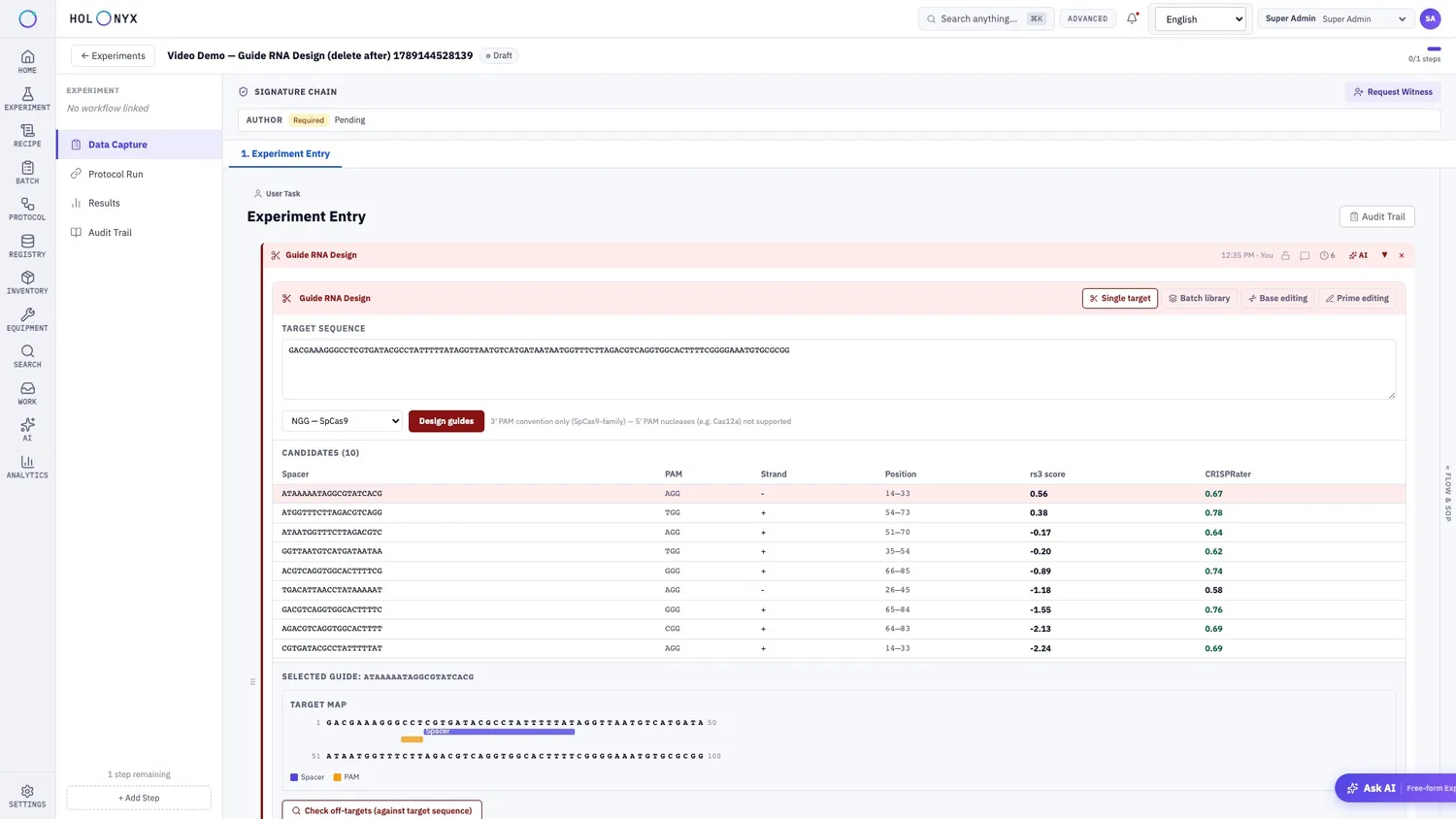
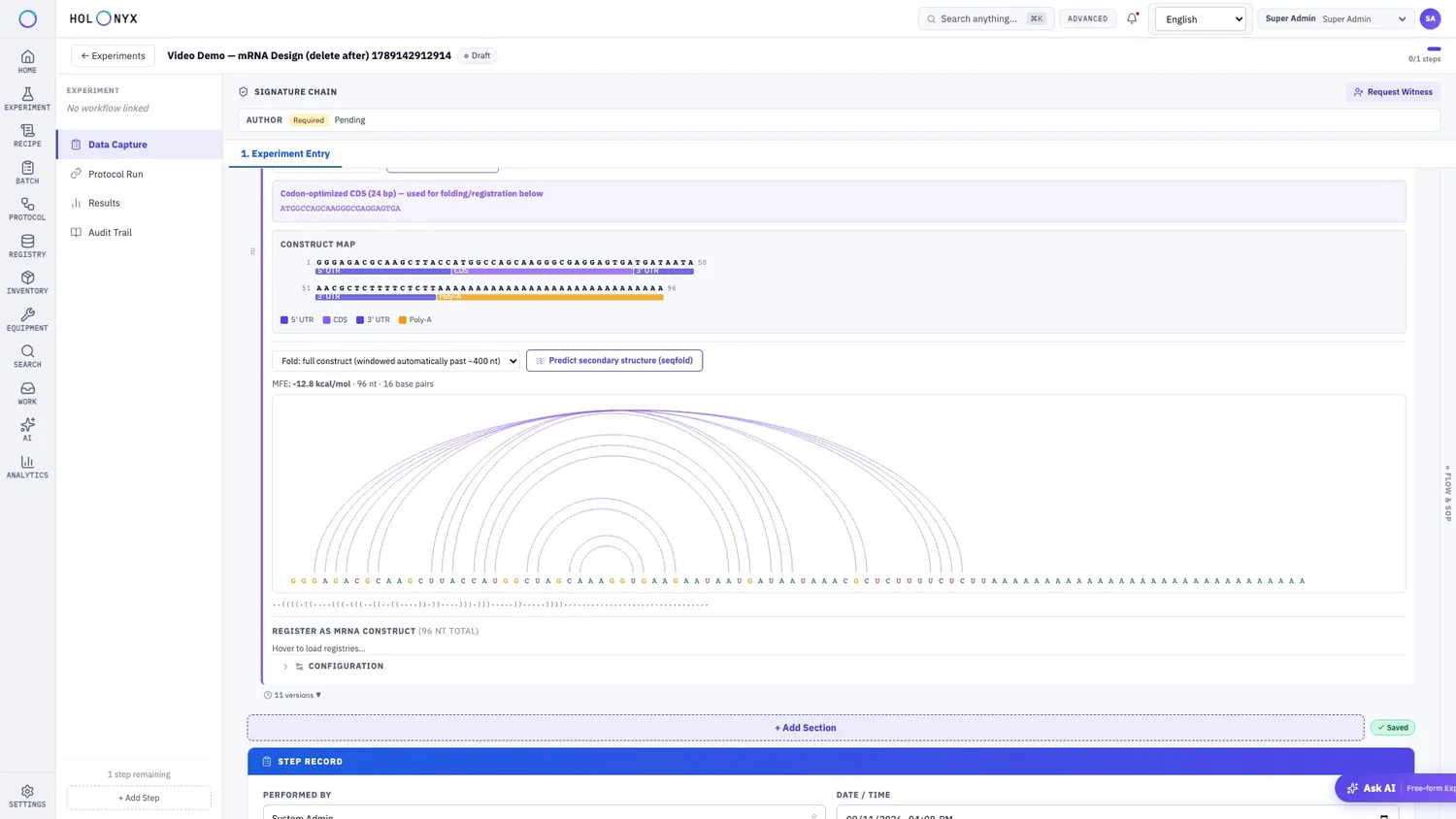
- Mol* 3DPDB ID, AlphaFold UniProt ID or .cif/.pdb
- Plasmid mapGenBank to circular and linear map, with in-app editing
- Sequence viewerFASTA or UniProt ID with live annotations
- Flow cytometryFCS 3.0/3.1 scatter, histograms and gating
- Mol propertiesSMILES, CAS or name to RDKit and hazard data
- NMR spectrumJCAMP-DX 1D spectra with peak picking
- ChromatogramHPLC/GC/SEC with auto peak detection
- Gel / SDS-PAGESynthetic or uploaded gels on real MW ladders
- Guide RNA designPAM scan, scoring, off-target check, register
- Primer designPrimer3 PCR and Gibson primers with checks
- mRNA designUTR / CDS / poly-A, codon optimization, folding
- Antibody designHumanization and developability, CDR by CDR
Registries
Governed master data for compounds, constructs and cell lines.
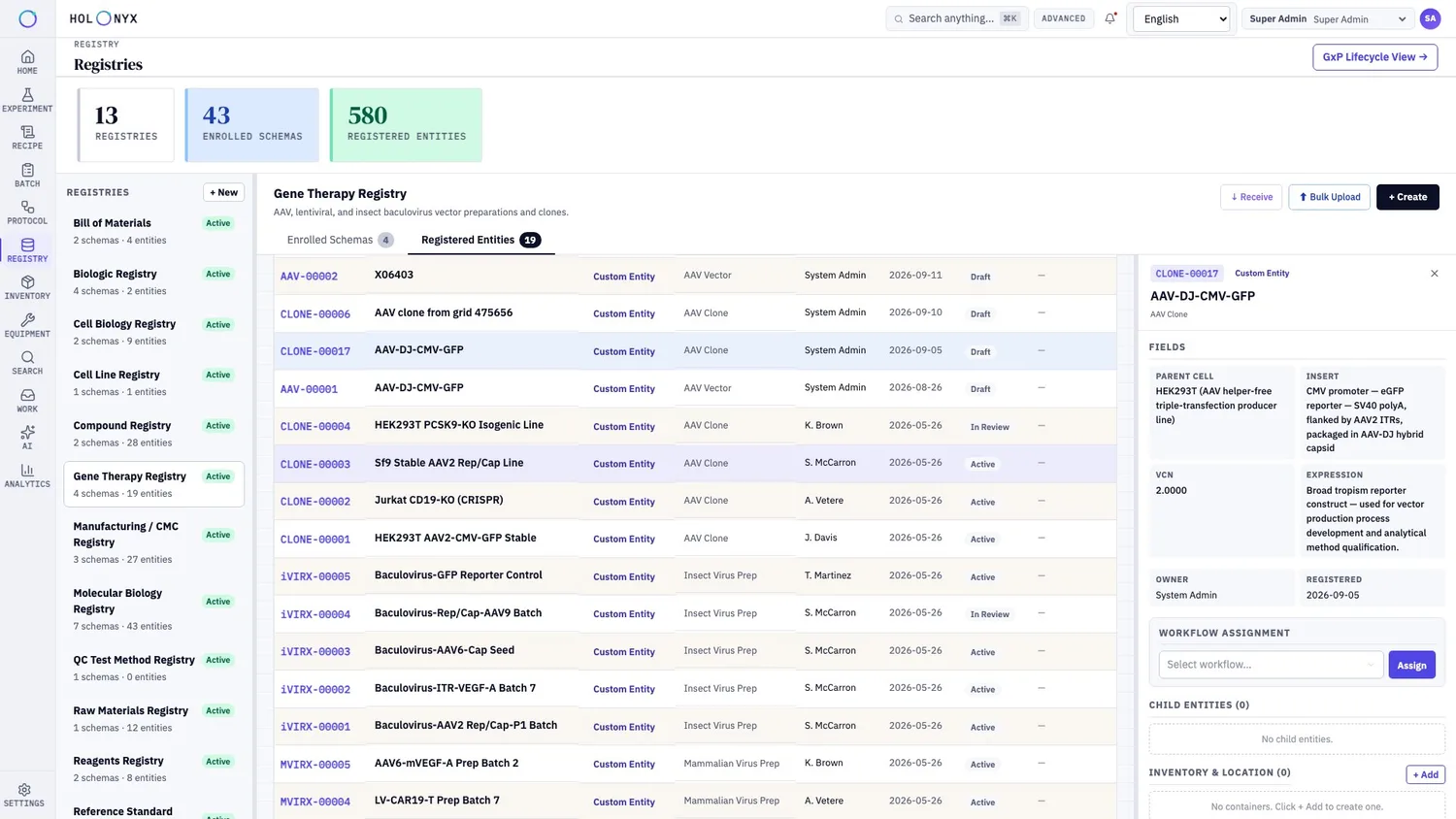
Registries are configured by admins from entity schemas, so your own definitions — not a generic template — drive the forms. Register from a stoichiometry product, a guide-RNA design or a plasmid, with consistency checks on the way in.
- Guided registration: type, then schema, then fields
- Registry Explorer browses across every registry with structure rendering
Inventory
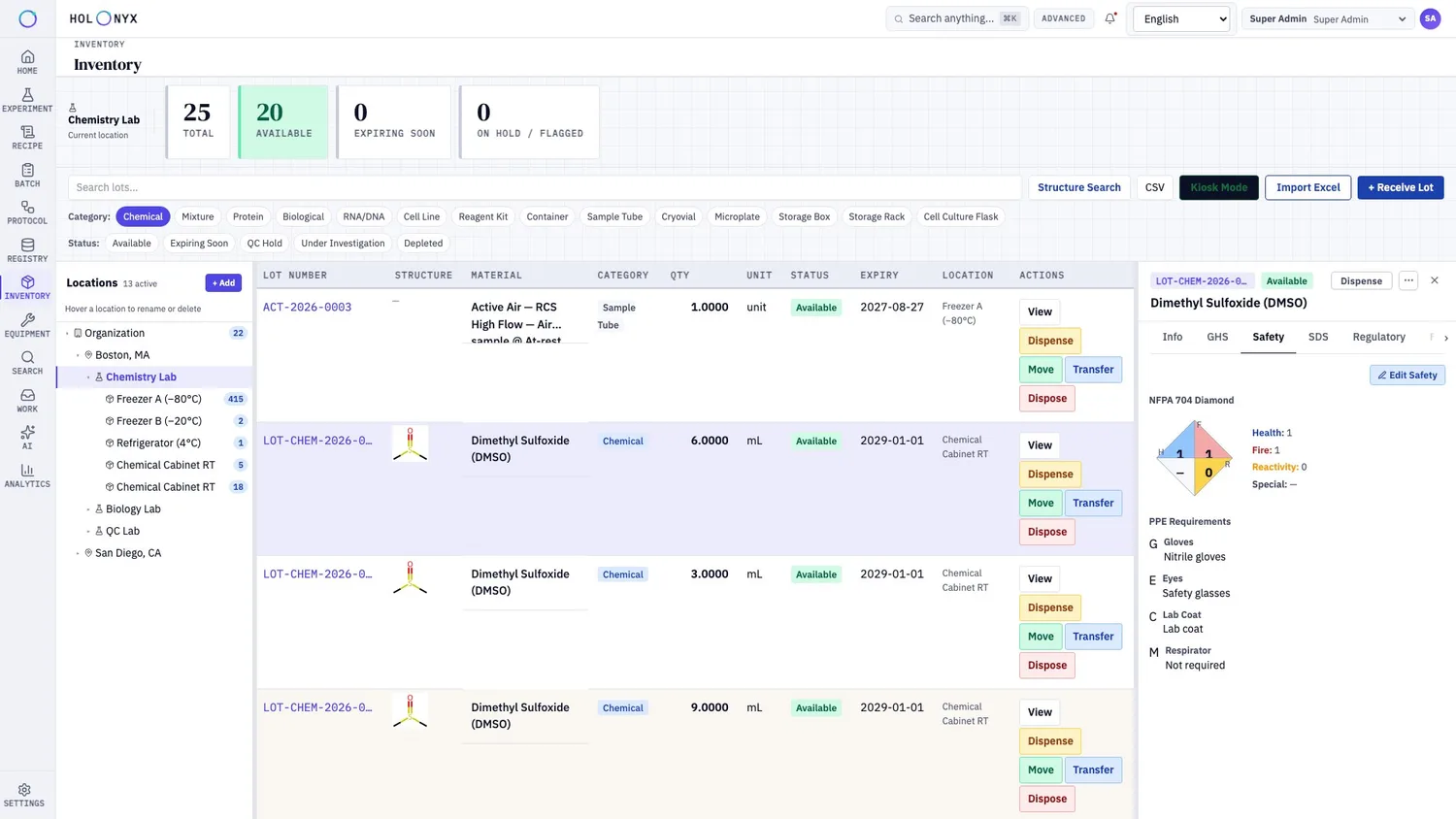
Lots, hazards, locations, and a barcode kiosk.
Materials are referenced by the experiment step that used them, so consumption is recorded where it happens.
- Locations: organisation, site, lab, freezer and cabinet, each with a live lot count.
- Hazards on the lot: GHS pictograms, H/P codes, NFPA rating, PPE, SDS.
- Expiry and status: warnings, QC hold blocks consumption, per-lot history.
- Kiosk mode for touch and barcode-driven receive, move, transfer and dispose.
Witness & sign
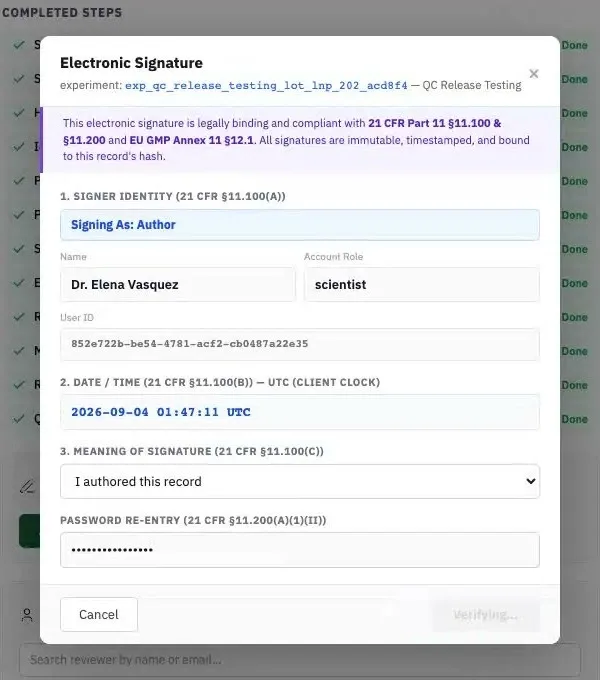
The signature chain is part of the record.
Author, witness, reviewer. A witness can sign or return for changes; every signature captures identity, UTC time, a meaning statement and a password re-entry. Once released, a record changes only through a new, fully signed revision.
- Meaning statements: authored, witnessed, reviewed, approved
- Every state transition is an audit-logged event tied to the user
Search & knowledge graph
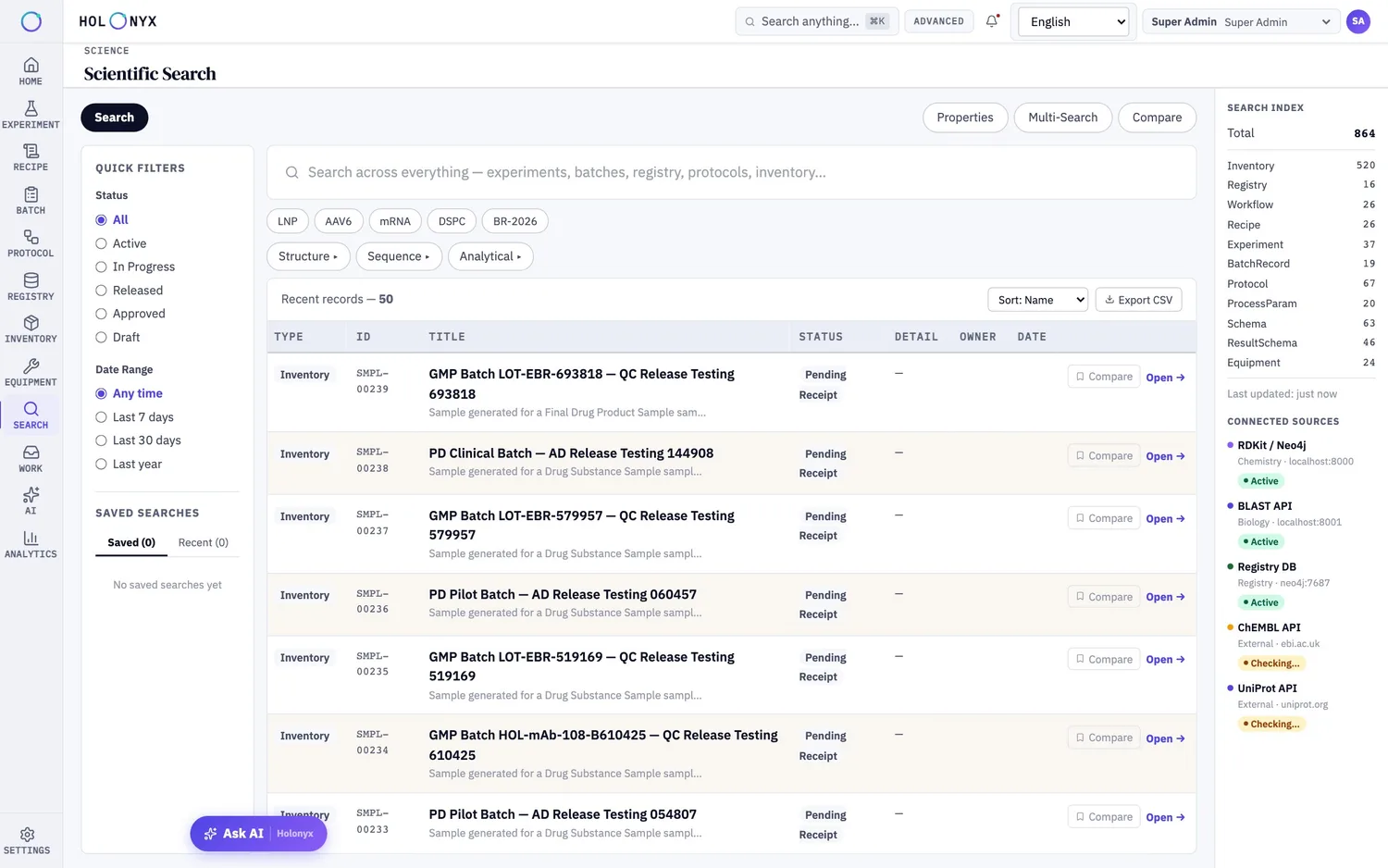
Search by structure, sequence or text, and see the graph behind it.
Scientific Search covers free text, chemical structure (exact, substructure, similarity), biological sequence and property queries. The Knowledge Graph Browser makes the lineage visible.
Put your next experiment on a record that goes all the way to release.
A working session with the team that built it — your modality, your compliance regime, your instruments.