
— Platform · Lab & QC →
A lab system that shares its data model with the notebook and the batch record.
A test request is a node linked to the sample, the method, the batch and the experiment that asked for it — and results land against a versioned schema, judged as they are captured.
End to end
From sample to Certificate of Analysis.
Request
Raised from an experiment, protocol or batch, with a method.
Sample
Registered, labelled and stored; lot expiry and QC hold enforced.
Test
Instrument checked for calibration; result posted by gateway or entered.
Evaluate
Checked against specification limits as it is captured.
Review
Reviewer signs or returns; the signature chain is recorded.
Release
Certificate of Analysis generated from live results, hash-stamped.
An out-of-specification value raises a quality event the moment it is captured. Expired lots raise validation errors, QC-hold lots cannot be consumed, and out-of-calibration instruments are refused. Every step is a hash-chained audit event.
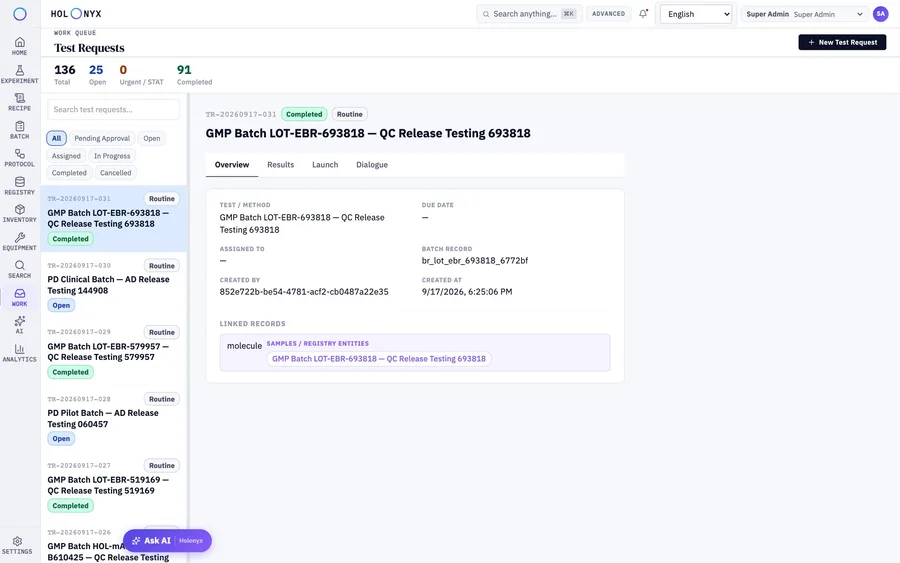
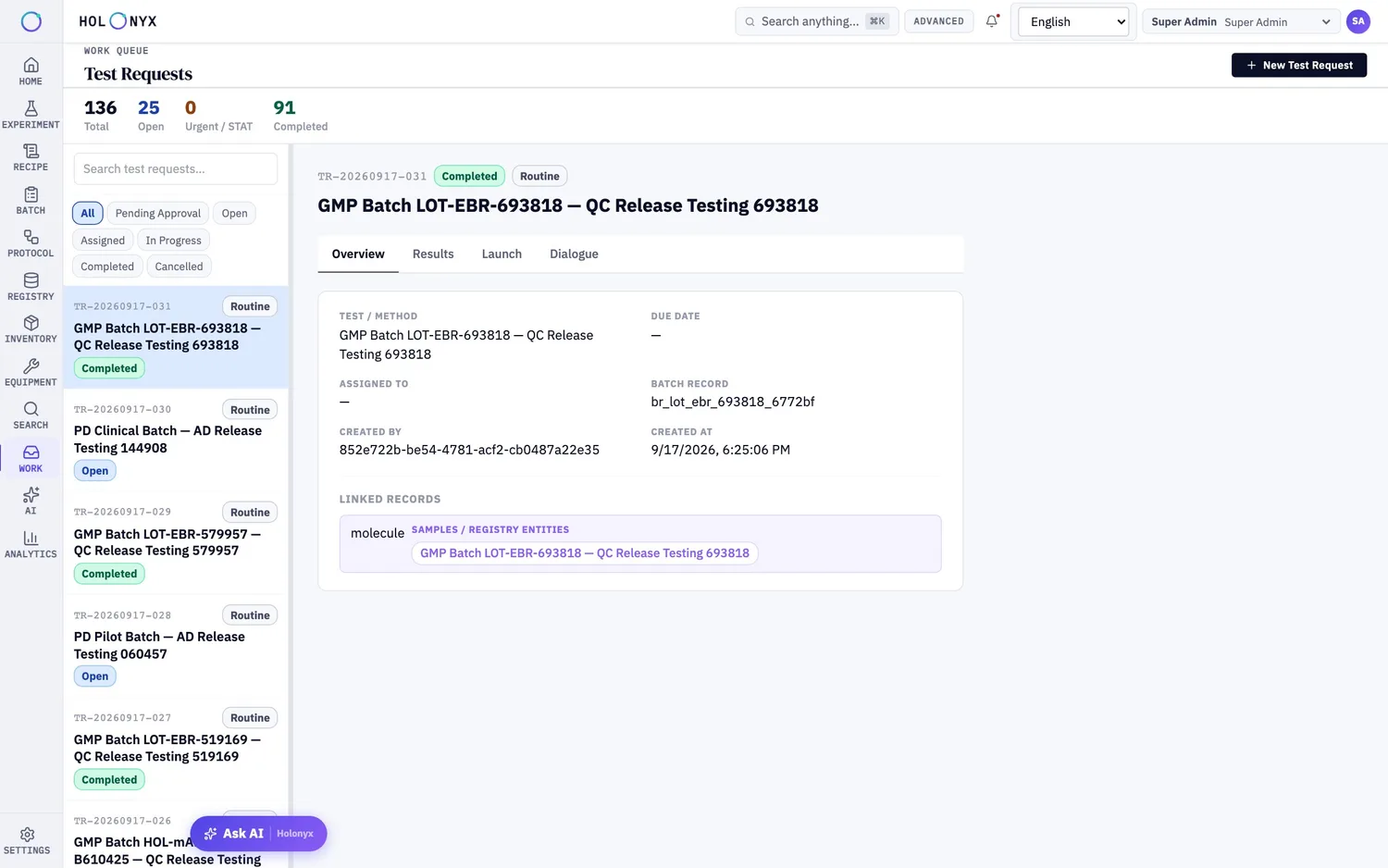
Test requests
One queue from request to result.
Requests link to the batch record, samples and registry entities they test, and are raised in context — from an experiment, a protocol run or a batch — so the context travels with them.
- Queue states: pending approval, open, assigned, in progress, completed, cancelled
- Results attach to the request against the method’s result schema
Method Library
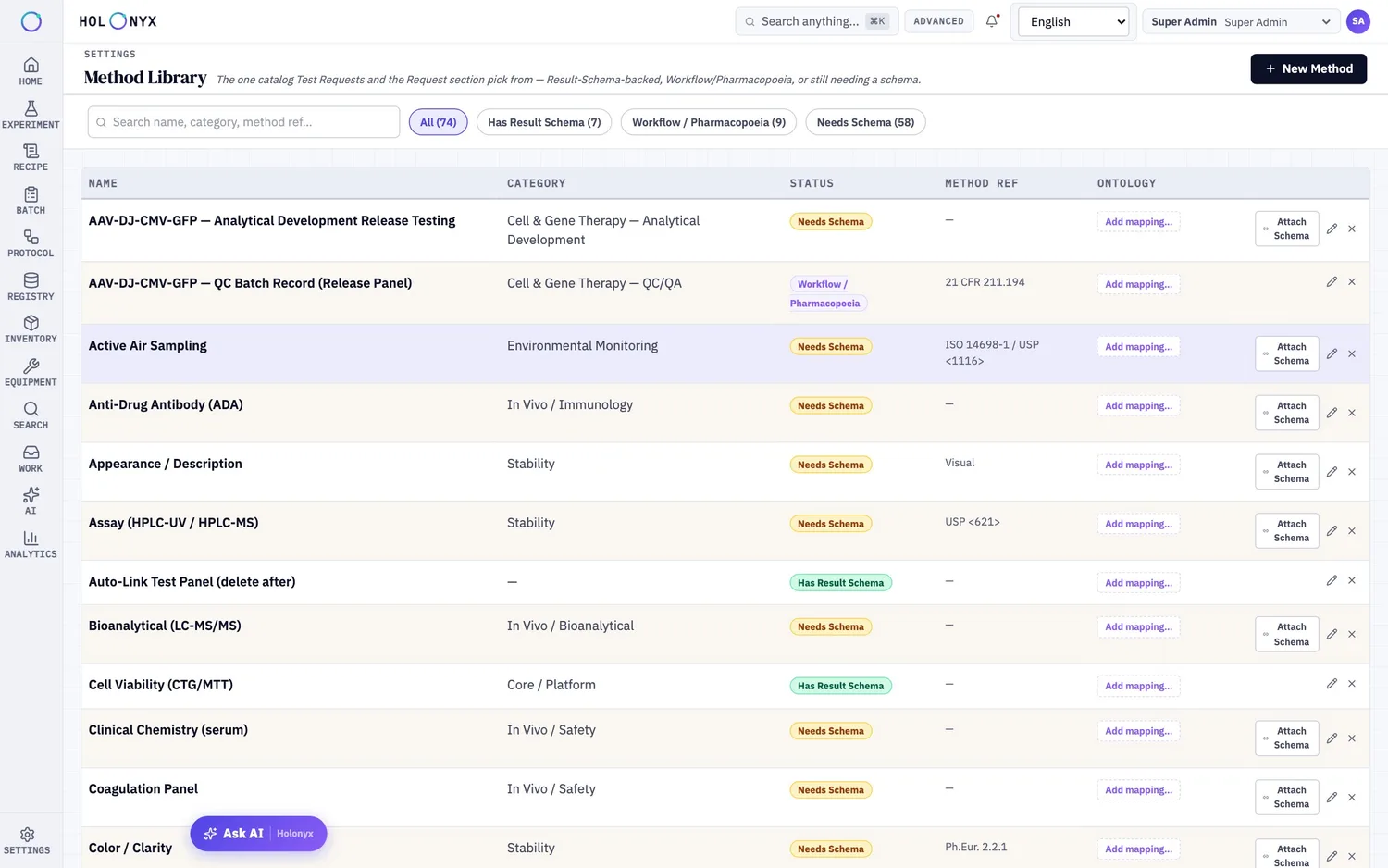
One catalog behind every request and protocol.
Test requests, the request section inside an experiment and the protocol designer’s checklists all pick from the same list of methods — each flagged as schema-backed, workflow or pharmacopoeia-backed, or still needing a schema.
- Attach a result schema to make a method executable and comparable
- Map ontology terms so results are searchable by standard vocabulary
Result schemas
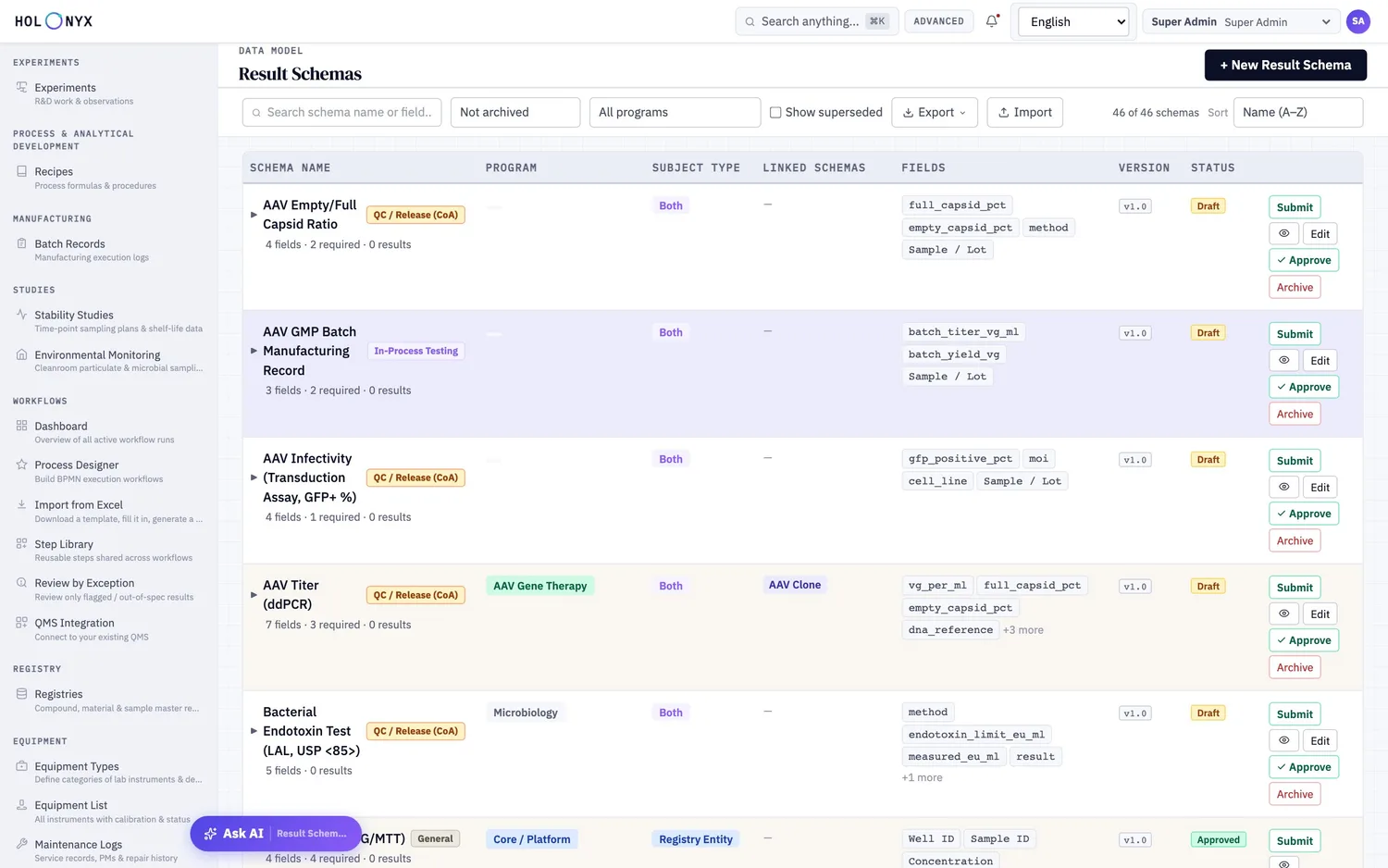
Versioned, locked definitions of every assay’s results.
Columns, data types, units and specification limits per method, with a purpose tag — stability, environmental monitoring, QC release or custom — that routes results to the right dashboard.
- Specification limits evaluated as values are entered
- Approved schemas are immutable; a change is a new version
- Approving a schema drafts its Performance Qualification protocol
Equipment & calibration
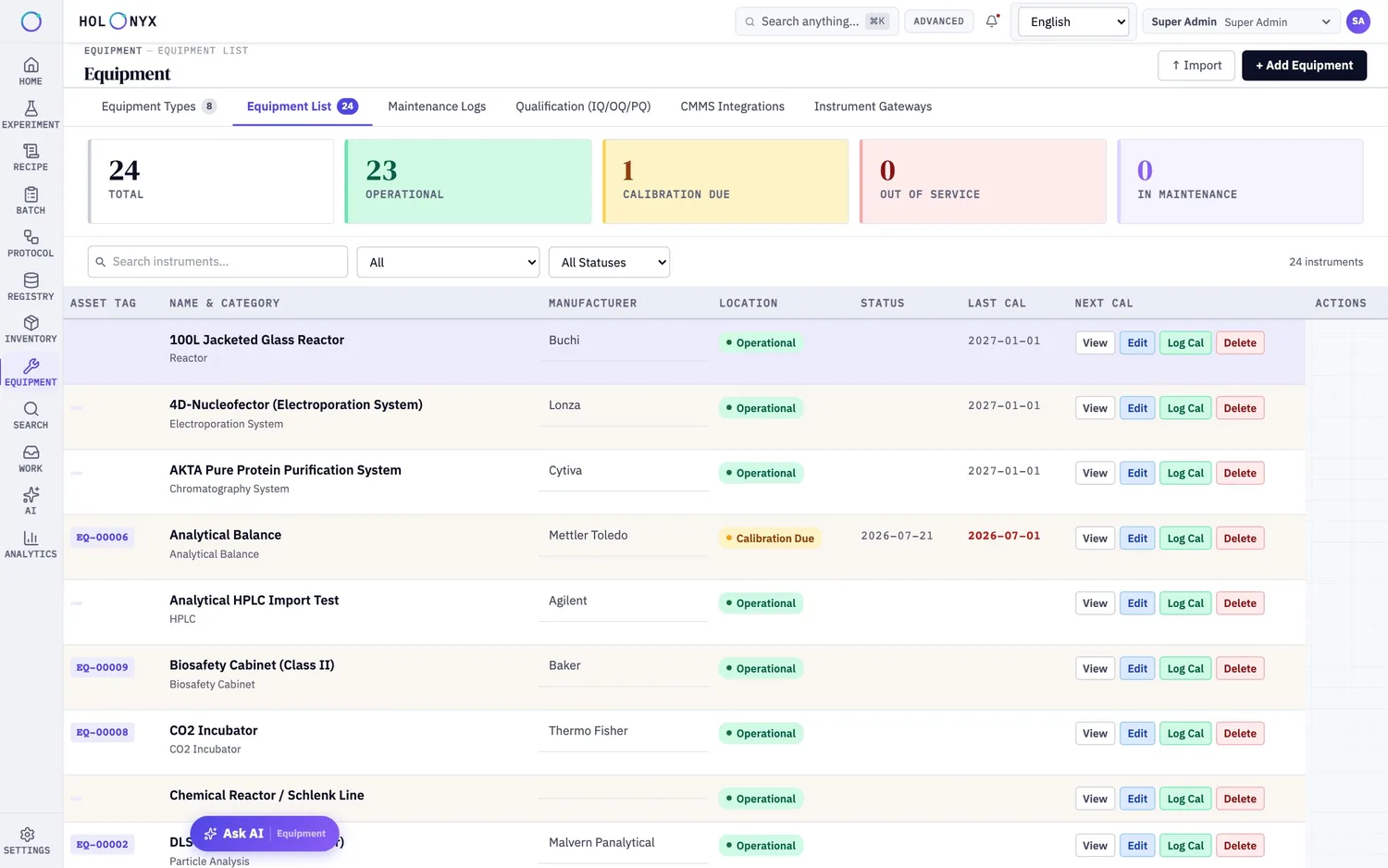
Qualification, calibration and maintenance on one register.
Every instrument carries qualification status, calibration due dates and maintenance history. Adding an out-of-calibration instrument to a record’s Equipment section is refused by the server — not just warned about.
- IQ/OQ/PQ tracking, maintenance logs and CMMS integration tabs
- Calibration due dates appear in the Work Queue and Calendar before they lapse
Instrument gateways
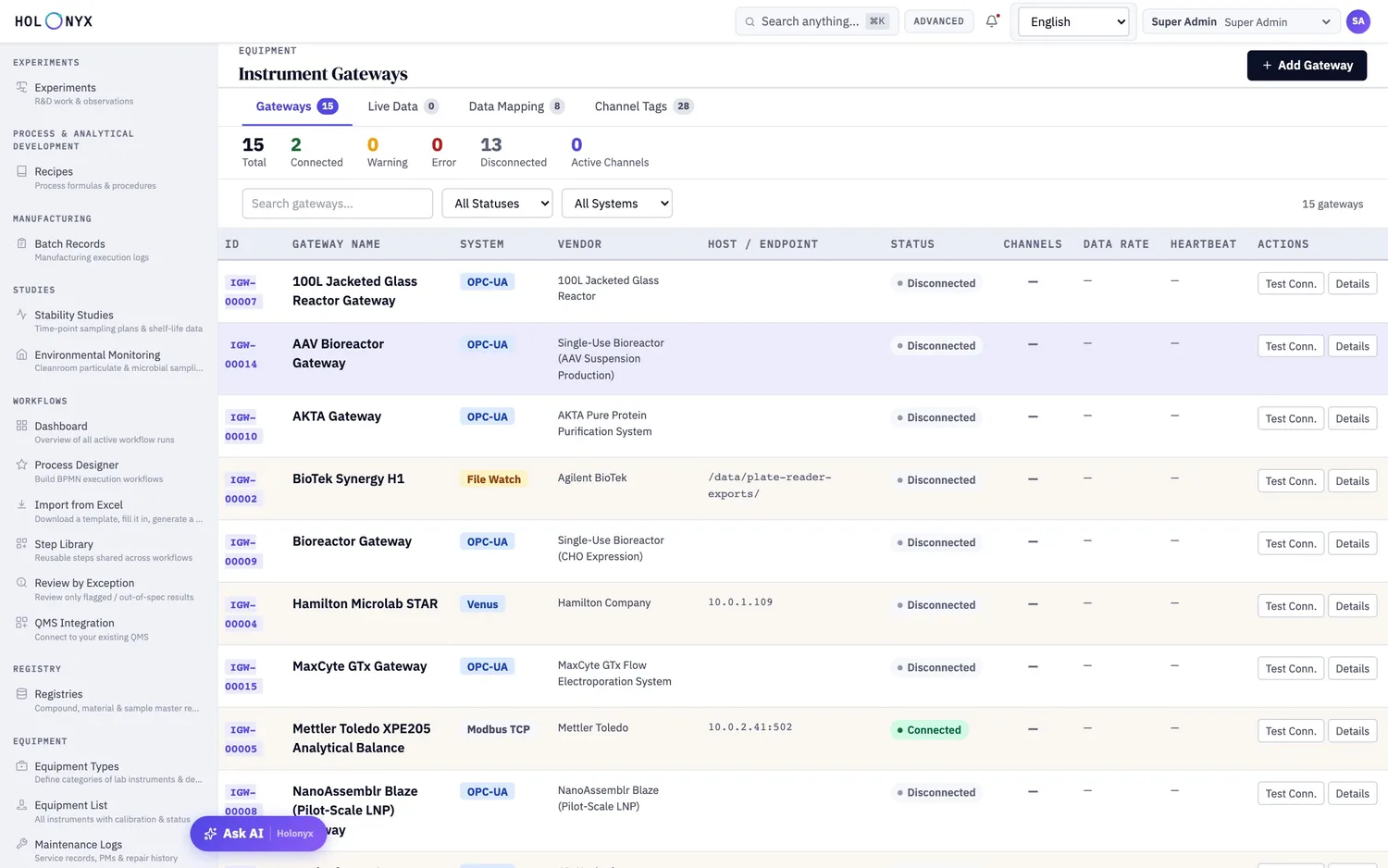
Results posted from the instrument, not typed from a display.
OPC-UA, Modbus TCP, file-watch and vendor-software adapters — such as Hamilton VENUS and Waters Empower — map instrument channels to result-schema columns and to the target record.
- Values are flagged as system-originated in the audit trail
- Editing one requires documented justification
Protocols & stability
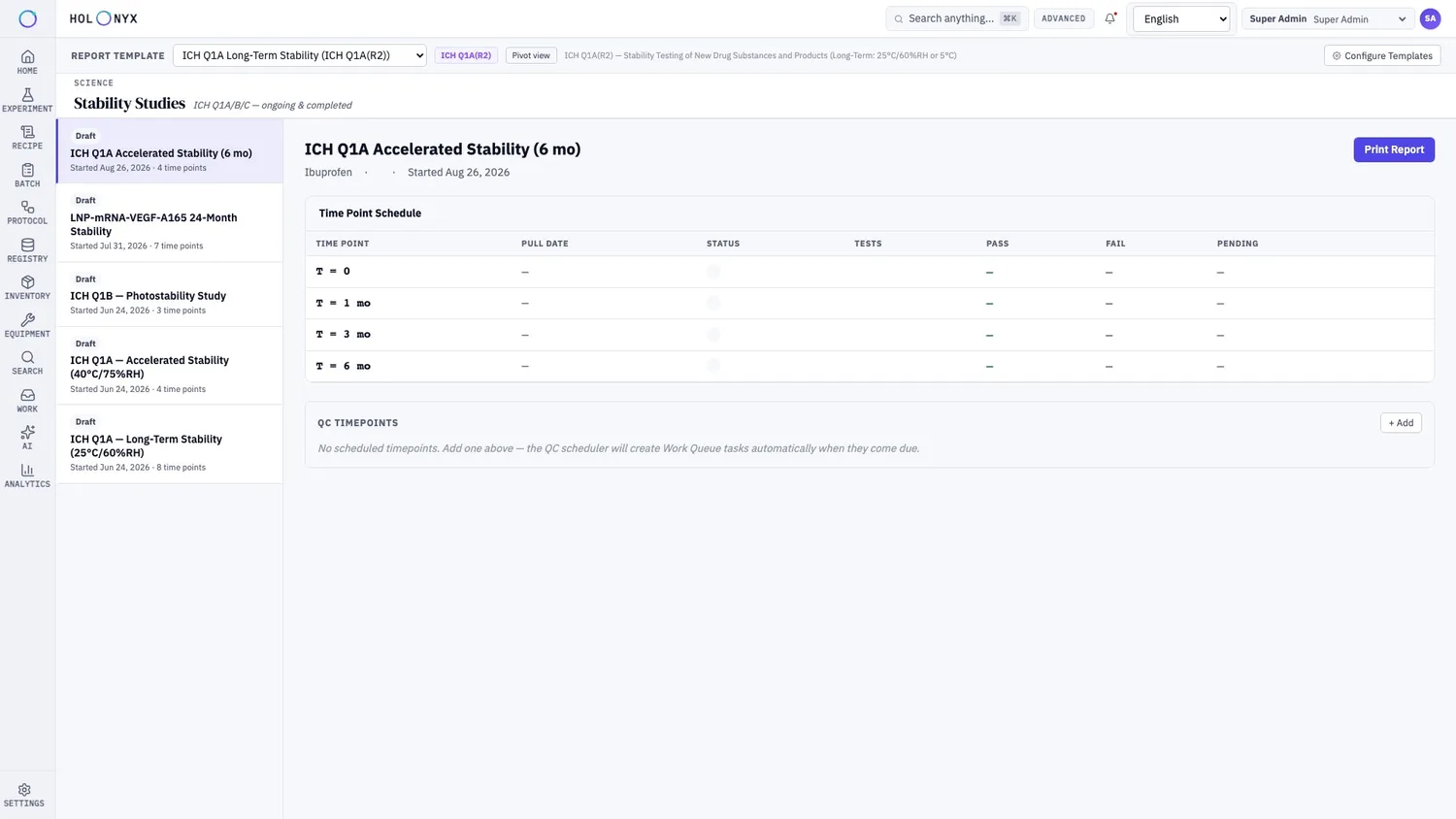
Study protocols as schedule grids — designed once, run many times.
ICH- and OECD-referenced templates for stability, in vivo PK, ADME, toxicology and environmental monitoring. A run instantiates the schedule against a real study, and pull dates create work-queue tasks automatically.
- Time points, sample matrices and specification limits are data, not an SOP
- Trending with OOT detection and shelf-life prediction per ICH Q1E
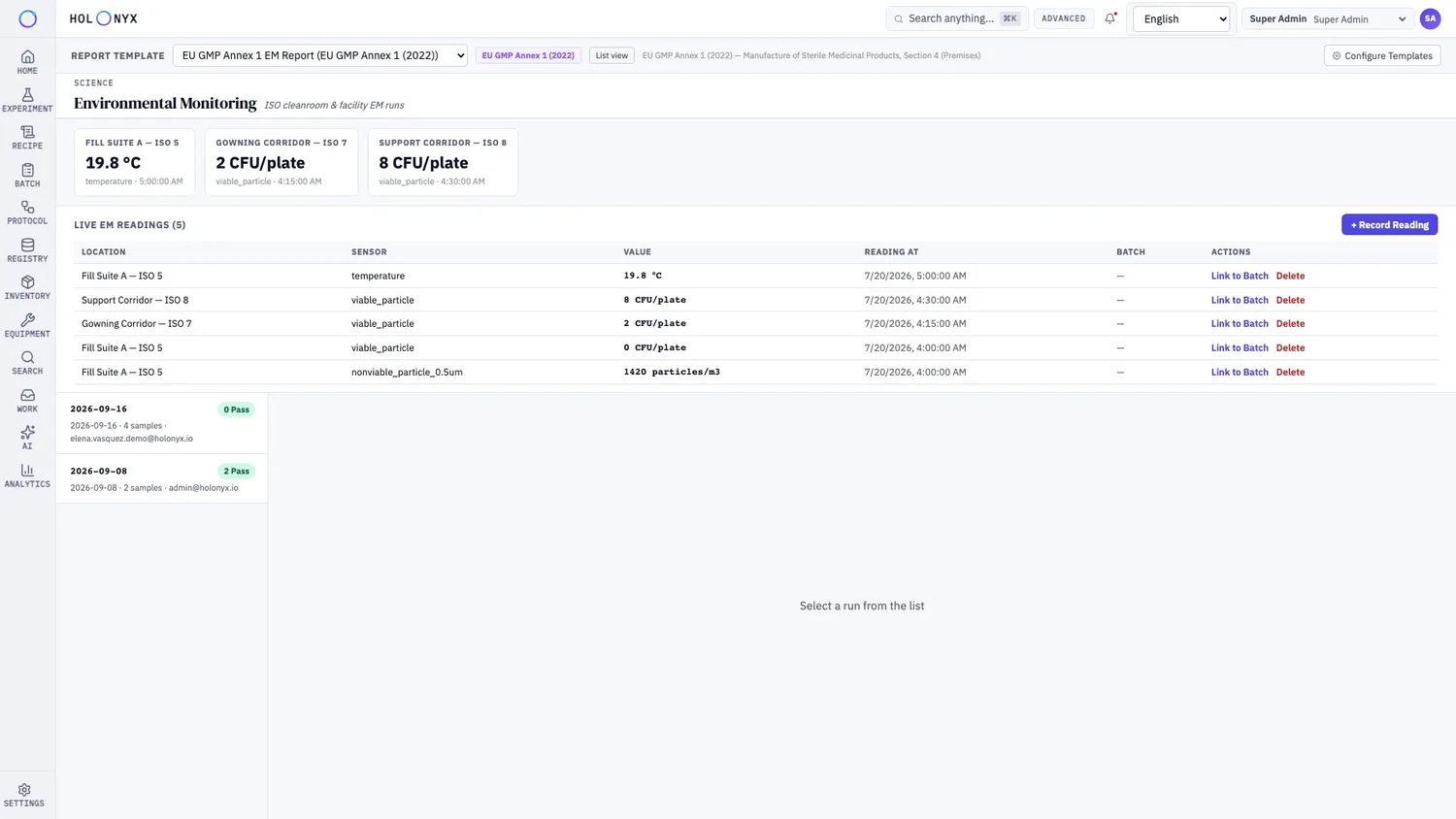
Environmental monitoring
Cleanroom readings, linked to the batches they protect.
Viable and non-viable counts and temperature post against classified zones, with EU GMP Annex 1 (2022) and ISO 14644 report templates. An excursion is tied to the batch that was in the room.
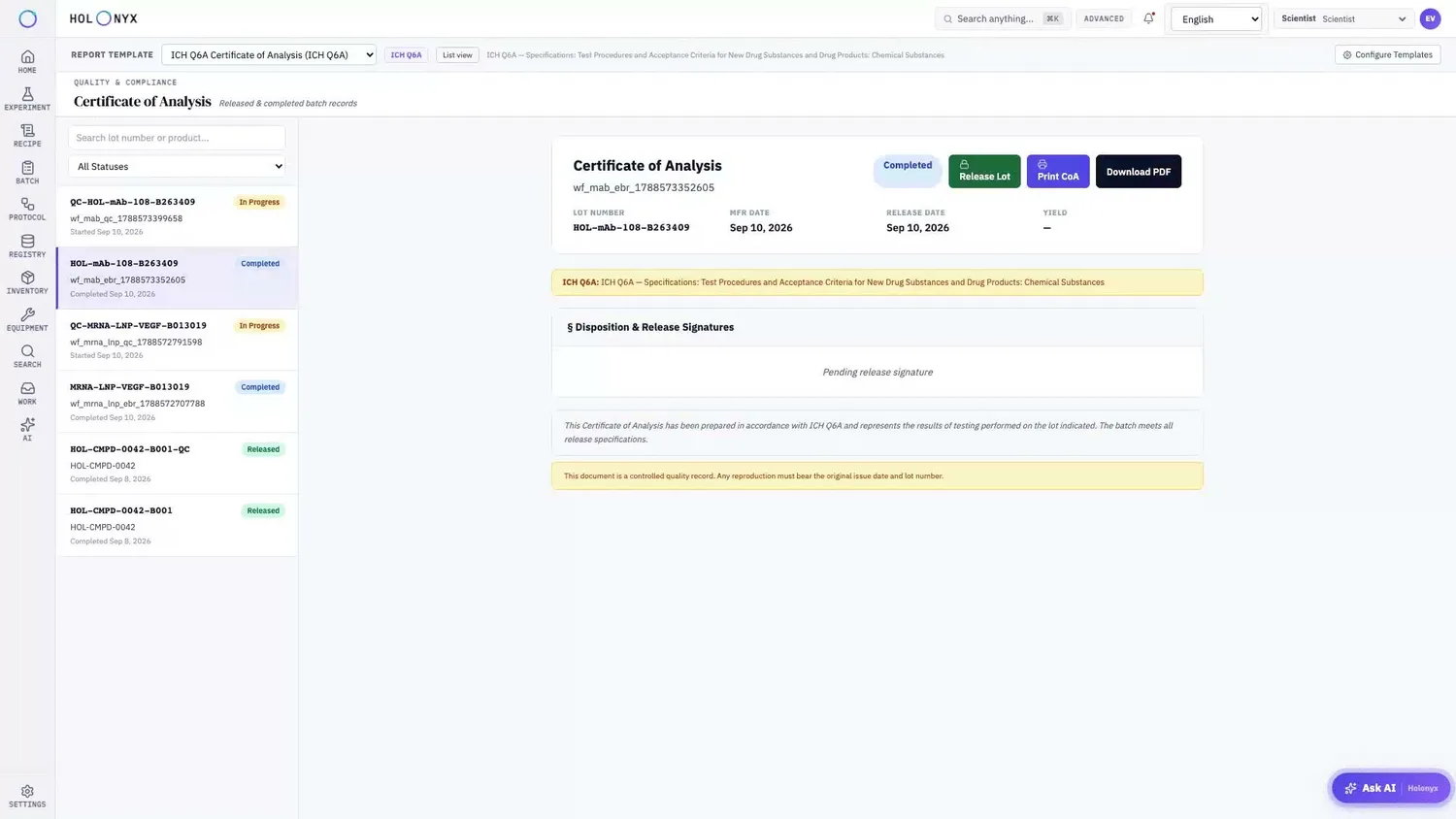
Certificate of Analysis
Generated from the released batch — not assembled by hand.
Product identity, QC results against specification and process parameters come from the batch record and its result schema. The PDF is generated server-side and carries the batch record’s SHA-256 hash in its metadata.
- Templates for ICH Q6A, USP and custom layouts
- Signature block printed from the e-signature record
Bring your QC lab’s most painful hand-off to the walkthrough.
A working session with the team that built it — your modality, your compliance regime, your instruments.